Cornflower & Poppy Fields — Alsace Plain
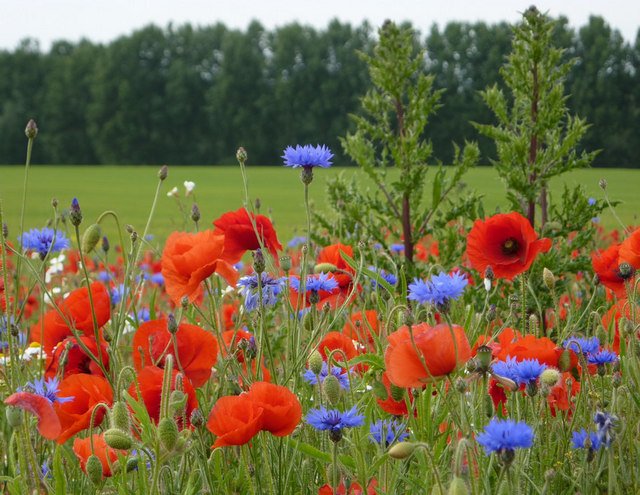
Each June and July, the organic and traditionally farmed cereal fields of the Alsace plain between Colmar and Sélestat produce one of France's most spectacular agricultural wildflower displays as cornflowers, poppies, corn marigolds, and chamomile colonise the field margins and unsprayed cereal crops in a polychrome mosaic of blue, red, yellow, and white that transforms the flat plain into a tapestry of colour beneath the backdrop of the Vosges mountains to the west and the Black Forest visible across the Rhine to the east. These 'messicoles' — flowers of the harvest — have largely disappeared from modern intensive farming across Western Europe, making the traditionally managed Alsatian cereal fields among the last places in France where the classic cornfield flower community survives at landscape scale. The cornflower blue against the golden wheat, photographed against a backdrop of Alsatian half-timbered villages and a stork nest on the church tower, creates one of the iconic French summer images. The same field margins support populations of corn bunting, grey partridge, and quail — all declining farmland birds that depend on the weed-rich field edges. The Alsace plain flower season coincides with the peak of the stork chick-rearing season and the beginning of the Alsatian wine harvest preparation in the hillside vineyards above.
About this spectacle
On the flat Alsace plain between Colmar and Sélestat, June and July transform traditionally farmed cereal fields into a polychrome tapestry of blue cornflowers, scarlet poppies, gold corn marigolds, and white chamomile. These 'messicoles' — flowers of the harvest — have vanished from most of Western Europe under intensive agriculture, making this one of the last places in France where the full cornfield flower community survives at landscape scale. Walking the field margins in morning light, visitors are surrounded by colour blocks shifting with the breeze, bees working the flowers, and the distant outline of the Vosges mountains to the west. Corn buntings deliver their jangling song from fence posts, grey partridges shuffle at field edges, and storks circle overhead during their chick-rearing peak. Half-timbered Alsatian villages and church towers topped with stork nests rise from the plain, completing a scene that feels simultaneously wild and deeply agricultural. The combination of wildflower colour, farmland birds, iconic architecture, and mountain backdrop makes this a rare multi-sensory summer spectacle.
When to go
Jan — Dec, peak Jun — Jul
Getting there
Nearest airport: EAP. Nearest city: Colmar.
Booking options
Goyova doesn't process bookings directly. When you tap "Plan this trip" in the app, you'll see options from our partner providers — accommodation, tours, transport — with affiliate links where applicable. See our affiliate disclosure for details.
More like this.
 Peak season
 Adonisröschen-Blüte Karlstadter Trockenrasen
Germany
 Peak season
 Adonisröschen-Blüte Kyffhäuser
Germany
 Peak season
 Agave Century Plant Mass Bloom — Oaxaca Mexico
Oaxaca City, Oaxaca, Mexico