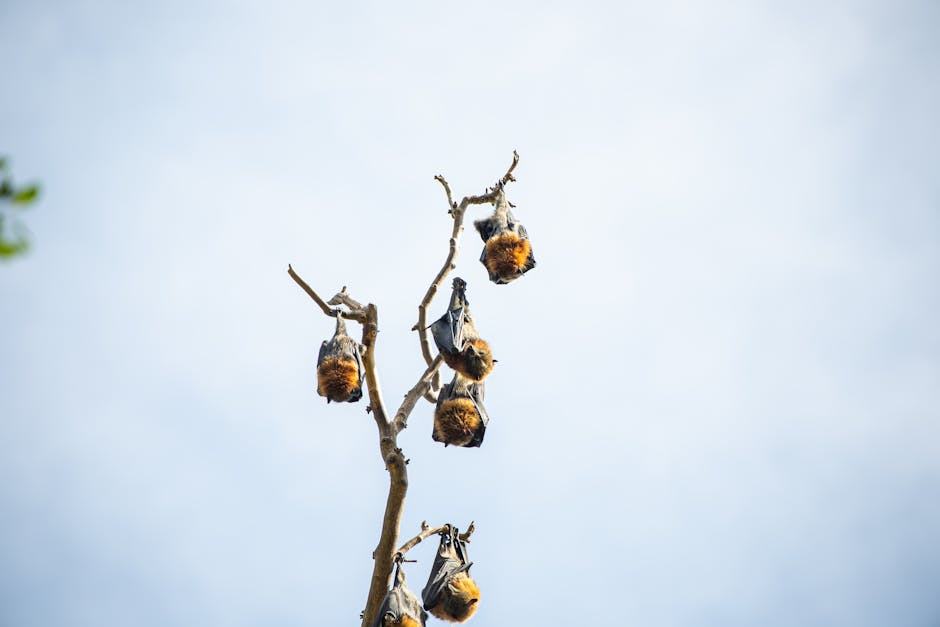
Straw-Coloured Fruit Bat — Eidolon Forest Ghana
Each November through March, the Boabeng-Fiema Monkey Sanctuary and the sacred forests of central Ghana host one of West Africa's largest accessible straw-coloured fruit bat colonies, with hundreds of thousands of bats roosting in specific sacred forest groves protected for generations by traditional beliefs that mirror modern conservation in their practical outcome — the bats' survival dependent on the continued vitality of Ghanaian forest protection traditions. The colony's evening emergence — a continuous stream of bats flowing from the canopy and spreading across the Ghanaian sky at dusk — creates a mini-Kasanka spectacle of considerable beauty in a West African context rarely visited by international wildlife tourists. The same sacred forest groves protect colobus monkeys and mona monkeys habituated to human presence over generations of protection, creating a wildlife encounter where monkeys feed just metres from visitors who move freely among the trees. The Boabeng-Fiema community conservation model — wildlife protected by traditional belief systems rather than government decree — provides a model of conservation anthropology of international significance that visiting tourists directly support through community-managed fees. The surrounding Brong-Ahafo region's traditional Ghanaian villages, kente textile traditions, and the historic Kumasi Ashanti cultural sites add a West African cultural dimension to a wildlife visit of genuine ecological importance.
About this spectacle
At dusk each evening from November through March, hundreds of thousands of straw-coloured fruit bats pour from the canopy of Boabeng-Fiema's sacred forest groves in a continuous, darkening stream against the Ghanaian sky. The sound builds before the sight — a rustling, leathery percussion from the roost above — before the bats spiral upward and fan outward in waves that can last for tens of minutes. The scale, while smaller than Zambia's Kasanka, is genuinely impressive in the West African context and rarely witnessed by international visitors. By day, the same grove offers something equally remarkable: black-and-white colobus and mona monkeys move through the trees just metres from visitors, habituated over generations to human presence by the community's traditional protection ethic. The forest itself feels intimate — cathedral-quiet in the heat of afternoon, then electric at dusk. A community guide walks with visitors through the understorey, where dappled light and birdsong accompany both the monkey encounter and the wait for the evening bat emergence.
When to go
Nov — Mar
Getting there
Nearest airport: KMS. Nearest city: Kumasi.
Booking options
Goyova doesn't process bookings directly. When you tap "Plan this trip" in the app, you'll see options from our partner providers — accommodation, tours, transport — with affiliate links where applicable. See our affiliate disclosure for details.
More like this.
 Peak season
 Aardvark Night Foraging — Kalahari Botswana
Maun, Central District, BW
 Peak season
 Aardvark Night Foraging — Kalahari South Africa
Upington, Northern Cape, South Africa
 Returns Jan 2027
 Adélie Penguin Highway — Ross Sea Antarctica
Cape Royds, Antarctica, AQ