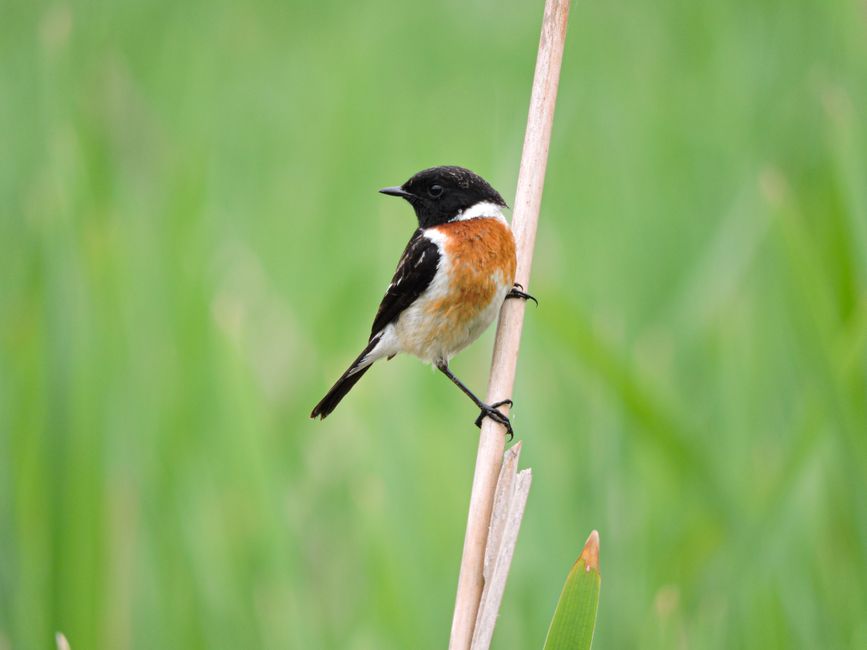
Stonechat & Dartford Warbler — Dorset Heaths
Each year on the ancient lowland heaths of Dorset — Hartland Moor, Arne, and Studland — the rare Dartford warbler maintains its only significant English stronghold, the male's long tail cocked and its scratchy song delivered from the top of a gorse bush in one of England's most sought-after resident bird encounters on a habitat type that has declined by 85% since 1800 and now exists only in fragments across the south of England. The Dartford warbler — named after the now-vanished heath where it was first described — is Britain's only resident warbler that does not migrate, surviving the harshest winters by skulking deep in the gorse and emerging only on mild days, and the combination of its rarity, its restricted habitat, and its jewel-like appearance — dark red below, slate-grey above, with a long graduated tail — makes it one of British birdwatching's most coveted encounters. Walking the Hartland Moor boardwalk or the Arne heathland trail in spring, with Dartford warblers singing from every clump of mature gorse and stonechats orange-breasted on the heather tops, surrounded by the open heathland and the distant blue of Poole Harbour, creates a Dorset wildlife experience of considerable richness. The dawn chorus on Dorset heath in April — nightingale, woodlark, and tree pipit joining the dartford warbler — is one of England's finest.
About this spectacle
On the ancient lowland heaths of Dorset — Hartland Moor, Arne, and Studland — visitors walk through a fragmented but extraordinarily rich habitat where the Dartford warbler clings on as Britain's only non-migratory warbler. In spring, males perch briefly atop mature gorse clumps, their long cocked tails and scratchy, rattling song making them momentarily conspicuous before they drop back into the scrub. Slate-grey above and dark red below, they are jewel-like against the yellow gorse blossom. Stonechats — burnt-orange breasted males ticking alarm calls from heather tops — are constant companions. Walking the Hartland Moor boardwalk or Arne heathland trail on a mild April morning, with Poole Harbour shimmering in the distance, the dawn chorus builds: woodlark, tree pipit, and nightingale join the warblers in an immersive soundscape. The habitat itself — open lowland heath, one of Europe's most threatened — deepens the encounter. Cold winters drive dartford warblers deep into gorse, so mild weather greatly improves sightings.
When to go
Jan — Dec, peak Mar — May
Getting there
Nearest airport: BOH. Nearest city: Poole.
Booking options
Goyova doesn't process bookings directly. When you tap "Plan this trip" in the app, you'll see options from our partner providers — accommodation, tours, transport — with affiliate links where applicable. See our affiliate disclosure for details.
More like this.
 Peak season
 Aardvark Night Foraging — Kalahari Botswana
Maun, Central District, BW
 Peak season
 Aardvark Night Foraging — Kalahari South Africa
Upington, Northern Cape, South Africa
 Returns Jan 2027
 Adélie Penguin Highway — Ross Sea Antarctica
Cape Royds, Antarctica, AQ