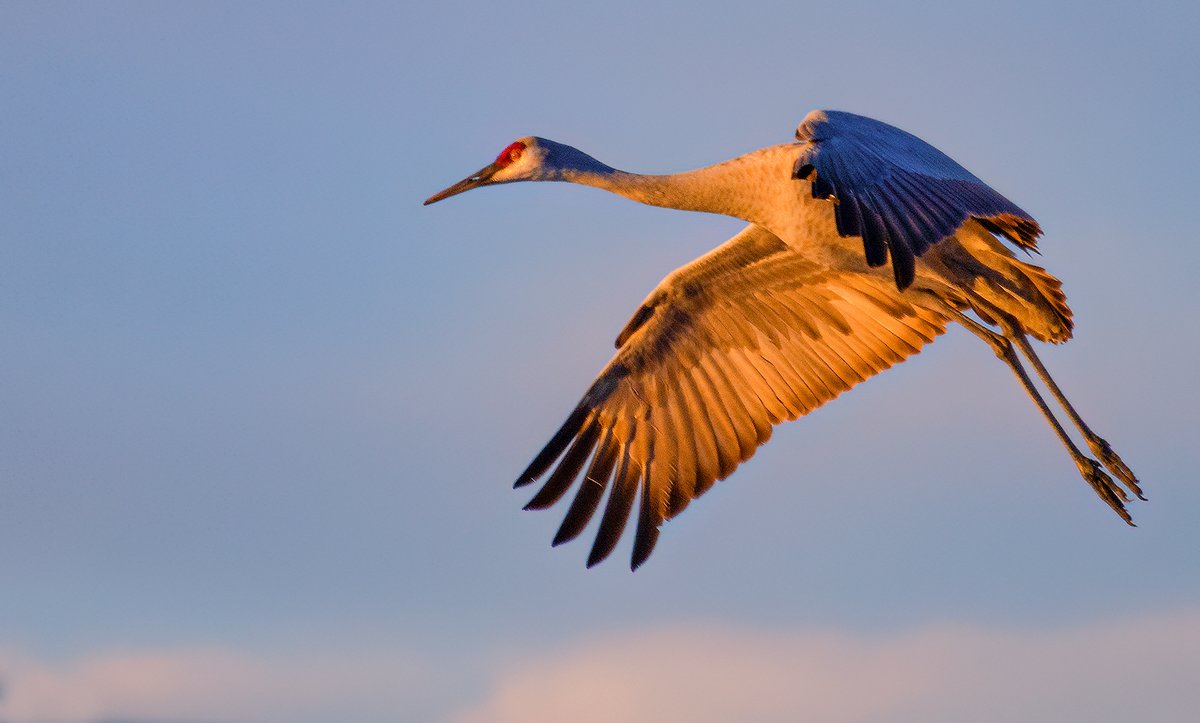
Sandhill Crane Roost — Platte River Nebraska USA
The sandhill crane (Antigone canadensis) spring staging on the Platte River in central Nebraska — 500,000 cranes stopping for 4–6 weeks in March on a 100-kilometre stretch of the Platte between Kearney and Grand Island, the world's largest concentration of any crane species and one of North America's finest wildlife spectacles — creates the continent's most overwhelming crane roost event. The dawn departure — the entire roost (500,000 birds) lifting from the shallow river braids simultaneously, the sky darkening with cranes for 20 minutes as they fan out to the surrounding cornfields — and the evening return (the reverse, with the sky filling progressively from 5pm until the river is solid cranes at dark) create two extraordinary daily events accessible from the Audubon Society's Iain Nicolson Audubon Center's blinds at the river's edge. The crane's ancient lineage (the fossil record extends 9 million years), the Platte's position on the Central Flyway, and the agricultural landscape's critical role create a migration spectacle of deep ecological layering.
About this spectacle
Each March, up to 500,000 sandhill cranes descend on a 100-kilometre stretch of the Platte River between Kearney and Grand Island, Nebraska, transforming the shallow braided river into one of the most overwhelming wildlife spectacles on the continent. At dawn, the entire roost erupts simultaneously — half a million birds lifting into the pale sky in a churning mass that darkens the horizon for a full twenty minutes before the cranes fan out to surrounding cornfields to feed. In the evening the process reverses: flocks stream back from 5pm onward, their bugling calls building to a roar as the river sandbars fill solid with birds by dark. Visitors watch from purpose-built blinds at the Iain Nicolson Audubon Center, just metres from the roosting birds. The soundscape alone — a continuous, surging chorus of bugling — is viscerally moving. The cranes' lineage stretches back nine million years, lending the spectacle a geological depth that amplifies its emotional weight. This 4–6 week window each spring is one of North America's finest wildlife experiences.
When to go
Mar
Getting there
Nearest airport: EAR. Nearest city: Kearney.
Booking options
Goyova doesn't process bookings directly. When you tap "Plan this trip" in the app, you'll see options from our partner providers — accommodation, tours, transport — with affiliate links where applicable. See our affiliate disclosure for details.
More like this.
 Peak season
 Aardvark Night Foraging — Kalahari Botswana
Maun, Central District, BW
 Peak season
 Aardvark Night Foraging — Kalahari South Africa
Upington, Northern Cape, South Africa
 Returns Jan 2027
 Adélie Penguin Highway — Ross Sea Antarctica
Cape Royds, Antarctica, AQ