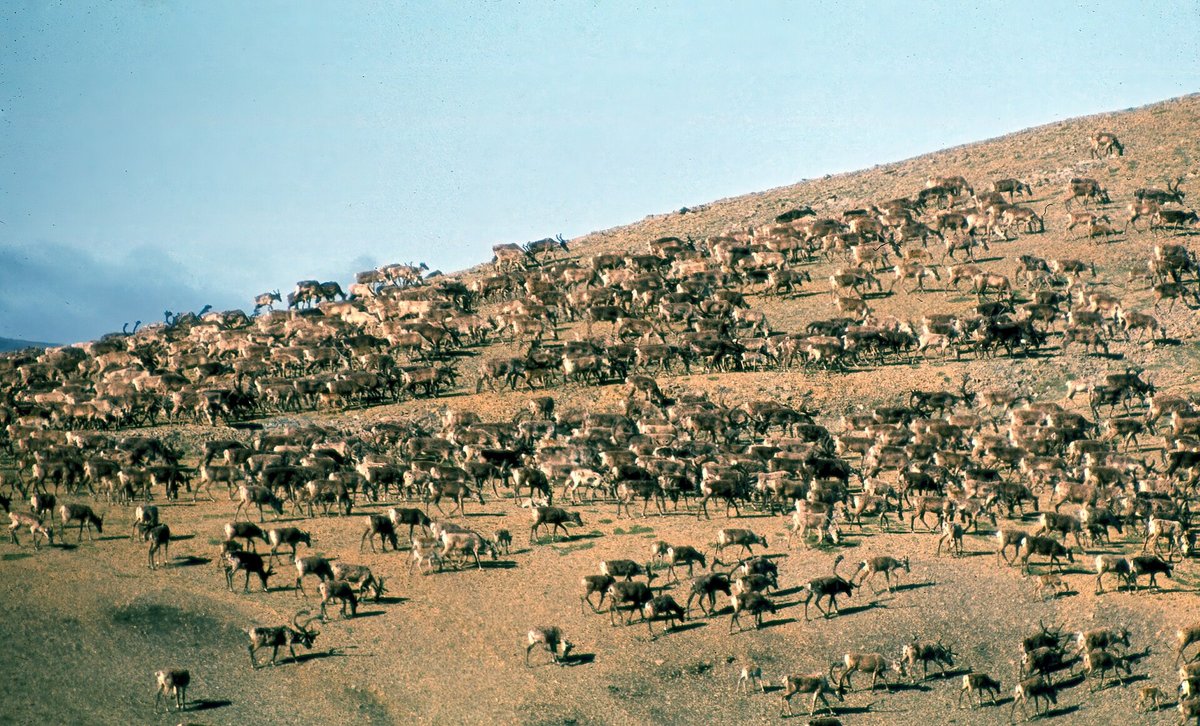
Porcupine Caribou Migration — Alaska Arctic USA
The Porcupine caribou herd's migration from their Yukon wintering grounds to the Arctic National Wildlife Refuge coastal plain calving grounds in Alaska is the longest terrestrial mammal migration in the Western Hemisphere — 1,500 kilometres annually, the herd of 197,000 animals crossing the Brooks Range in May and June in a movement visible from the air as a river of animals filling every valley. The June calving aggregation on the coastal plain produces the largest visible concentration of caribou in North America — the plain covered with cows and calves as far as binoculars can see — and the predator response (golden and bald eagles, grizzly bears, grey wolves, and wolverines all converging on the calving ground) creates the North American Arctic's most complete predator-prey spectacle. The ANWR's political protection status gives each visit an additional quality of witnessing one of North America's last intact large mammal ecosystems.
About this spectacle
Standing on the Arctic National Wildlife Refuge coastal plain in June, visitors witness one of Earth's great wildlife spectacles: the Porcupine caribou herd — nearly 197,000 animals — spreading across the tundra in every direction. The migration crossing of the Brooks Range in May and June appears from the air as a living river pouring through valleys. On the calving grounds, cows and newborn calves fill the plain to the binocular horizon, their low calls and the constant sound of hooves creating an almost physical presence. Converging predators intensify the drama: grizzly bears threading through the herd, golden and bald eagles circling overhead, grey wolves shadowing the edges, and wolverines opportunistically working the margins. The scale and wildness feel prehistoric. Wind off the Arctic Ocean is bitterly cold even in June, skies may be grey or brilliantly clear, and biting insects emerge as the season progresses. Access requires a bush plane. The experience is genuinely remote — no infrastructure, no crowds, just the herd and the predators that shaped this landscape over millennia.
When to go
May — Aug, peak May — Jun
Getting there
Nearest airport: FAI. Nearest city: Fairbanks.
Booking options
Goyova doesn't process bookings directly. When you tap "Plan this trip" in the app, you'll see options from our partner providers — accommodation, tours, transport — with affiliate links where applicable. See our affiliate disclosure for details.
More like this.
 Peak season
 Aardvark Night Foraging — Kalahari Botswana
Maun, Central District, BW
 Peak season
 Aardvark Night Foraging — Kalahari South Africa
Upington, Northern Cape, South Africa
 Returns Jan 2027
 Adélie Penguin Highway — Ross Sea Antarctica
Cape Royds, Antarctica, AQ