Leatherback Turtle Nesting — Trinidad
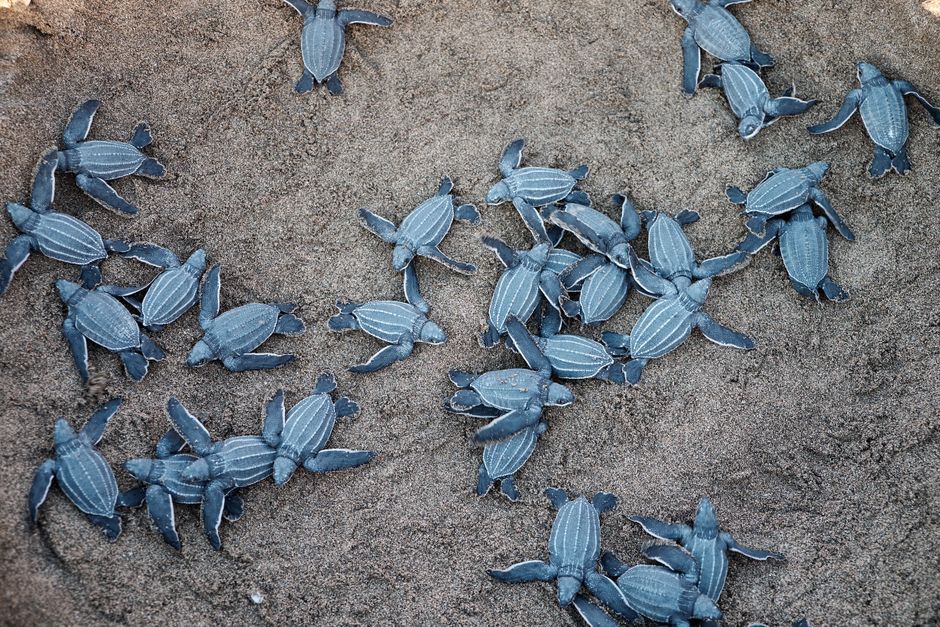
The beaches of Trinidad's north coast — particularly Grand Rivière and Matura — host the world's largest leatherback sea turtle nesting concentration, with up to 500 females coming ashore in a single night at Grand Rivière during the peak May nesting season, creating a beach so densely packed with nesting leatherbacks that latecomers climb over earlier nesters in their urgency to excavate and deposit their clutches. The leatherback is the world's largest living reptile — reaching 900 kg — and its nesting behaviour is among the animal kingdom's most ancient and powerful, the female's methodical excavation with her rear flippers creating a crater the size of a bathtub while tears clear sand from her eyes and her breathing creates a rhythmic rasping audible above the surf. Guided tours from the village of Grand Rivière are operated by community conservancies that replaced egg poaching with tourism income, creating a conservation model of genuine community benefit, and the combination of the turtle spectacle and the village's authentic Trinidad hospitality creates a wildlife encounter of warm cultural authenticity. The leatherback's genetic lineage extends 100 million years unchanged to the age of the dinosaurs, and watching one emerge from the same ocean it has navigated for a century of individual life to this precise beach creates an encounter across deep geological time of considerable philosophical weight. The hatching of thousands of tiny leatherbacks in July and August creates a separate equally moving spectacle.
About this spectacle
On certain nights in May, Grand Rivière beach becomes something almost impossible to believe: up to 500 leatherback sea turtles emerge from the Caribbean simultaneously, their dark, ridged shells emerging from the surf in the moonlight, their laboured breathing creating a rhythmic rasping that rises above the waves. These are the largest reptiles on Earth — some approaching 900 kg — and each female hauls herself up the sand with ancient, unhurried determination, excavating a bathtub-sized crater with her rear flippers while tears stream down her face to clear sand from her eyes. The beach grows so crowded at peak that latecomers physically climb over earlier nesters. Guided by community conservancy rangers who replaced poaching with protection, visitors stand metres away in the warm tropical night, witnessing behaviour unchanged for 100 million years. From July into August, the spectacle shifts: thousands of tiny hatchlings erupt from the sand and scramble toward the sea, a second act of equal emotional power.
When to go
Mar — Aug, peak May
Getting there
Nearest airport: POS. Nearest city: Port of Spain.
Booking options
Goyova doesn't process bookings directly. When you tap "Plan this trip" in the app, you'll see options from our partner providers — accommodation, tours, transport — with affiliate links where applicable. See our affiliate disclosure for details.
More like this.
 Peak season
 Aardvark Night Foraging — Kalahari Botswana
Maun, Central District, BW
 Peak season
 Aardvark Night Foraging — Kalahari South Africa
Upington, Northern Cape, South Africa
 Returns Jan 2027
 Adélie Penguin Highway — Ross Sea Antarctica
Cape Royds, Antarctica, AQ