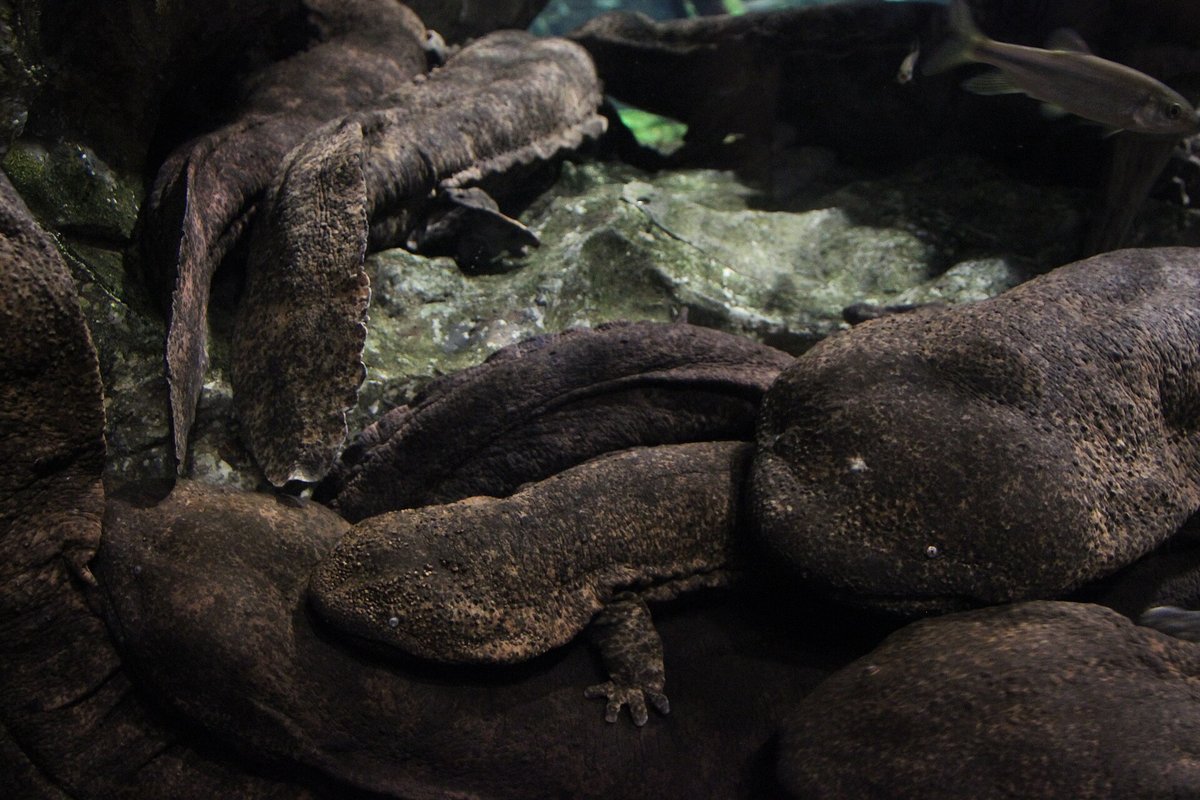
Japanese Giant Salamander Spawning — Chugoku Mountains
The Japanese giant salamander is the second-largest amphibian on Earth — a fully aquatic creature reaching 1.5 metres and 25 kilograms, breathes through its wrinkled skin, and inhabits only the clean, cold, oxygen-rich mountain streams of western Japan's Chugoku Mountains. Each August the adults converge on specific large stream boulders where a dominant male guards a hollowed undercut — the 'nest-hole owner' — to which females migrate to deposit eggs which the male then fertilises and guards for weeks. The spawning aggregation involves multiple males attempting to enter the nest hole simultaneously, resulting in thrashing masses of enormous prehistoric-looking salamanders in crystal-clear water that can be observed by snorkellers and underwater observers from August through October. The species is culturally sacred in parts of Hiroshima Prefecture and features on local pottery and food as a symbol of ecological purity.
About this spectacle
In the cold, crystalline streams threading through the Chugoku Mountains, August brings one of Japan's most extraordinary and rarely witnessed wildlife events. Japanese giant salamanders — prehistoric, wrinkle-skinned creatures up to 1.5 metres long and 25 kilograms — gather around specific submerged boulders where dominant males have claimed and hollowed out nest chambers beneath the rock. Females migrate to these sites and deposit eggs, triggering a chaotic, churning spectacle as rival males jostle and thrash in mass competition to enter the nest hole. Observers willing to snorkel or wade into the cold mountain water can watch these massive, ancient-looking animals writhing in clear currents, their pale, fleshy bodies twisting against each other in near-total darkness. The experience is disorienting in scale — these are not small creatures glimpsed at a distance, but animals approaching human body length, visible at arm's reach. Post-spawning, the male remains to guard the eggs for weeks. The spectacle runs August through October, with peak activity at night, in streams that must remain exceptionally clean to support the species.
When to go
Aug — Oct, peak Aug — Sep
Getting there
Nearest airport: HIJ. Nearest city: Hiroshima.
Booking options
Goyova doesn't process bookings directly. When you tap "Plan this trip" in the app, you'll see options from our partner providers — accommodation, tours, transport — with affiliate links where applicable. See our affiliate disclosure for details.
More like this.
 Peak season
 Aardvark Night Foraging — Kalahari Botswana
Maun, Central District, BW
 Peak season
 Aardvark Night Foraging — Kalahari South Africa
Upington, Northern Cape, South Africa
 Returns Jan 2027
 Adélie Penguin Highway — Ross Sea Antarctica
Cape Royds, Antarctica, AQ