Fossa Hunting — Kirindy Forest Madagascar
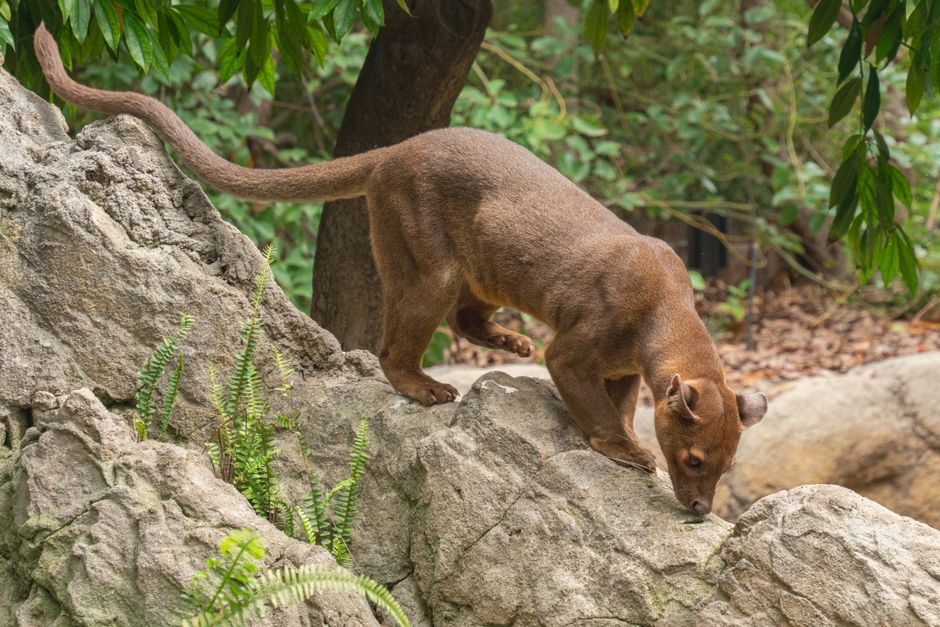
The Kirindy dry deciduous forest of western Madagascar is the best location in the world to observe the fossa — Madagascar's largest carnivore and the island's equivalent of a big cat, a sleek chestnut-brown predator related to the mongoose that can climb trees with feline agility and hunts lemurs and other mammals up to its own size. The Kirindy research station's decades of fossa study have created a semi-habituated population whose known individuals can be tracked by researchers and guided groups, and October's fossa mating season — when females come into oestrus simultaneously and multiple males queue to mate with each female over a three-day period in the forest canopy — creates one of wildlife biology's most extraordinary spectacles. The mating tree — a specific tall tree where females receive up to ten males in succession over several days — becomes an extraordinary focal point where observers can watch this apex predator's reproductive behaviour at close range in full daylight. The Kirindy forest is also the best location to observe the giant jumping rat, the nocturnal narrow-striped mongoose, and the mouse lemur — the world's smallest primate — making guided night walks among the most productive short wildlife transects in Madagascar. The forest's baobab trees and the extraordinary diversity of diurnal lemurs add daytime wildlife richness of considerable quality around the fossa encounters.
About this spectacle
Deep in western Madagascar's Kirindy dry deciduous forest, visitors encounter one of wildlife's most intimate predator experiences. The fossa — a sleek, chestnut-brown, cat-like carnivore capable of vertical tree-climbing — moves through dappled light as researchers help track known individuals. October brings the mating season's centrepiece: a single tall 'mating tree' where a female receives multiple males over several days in the forest canopy, fully visible from below in daylight. The sounds of rustling bark, the sight of males queuing patiently while the female controls access, and the scale of the encounter — an apex predator's most dramatic behaviour, within metres — are unlike anything available elsewhere. After dark, guided night walks reveal giant jumping rats bounding through leaf litter, narrow-striped mongooses threading through undergrowth, and mouse lemurs — the world's smallest primates — peering from the torchlight. Baobabs frame daytime lemur watching between fossa searches. The Kirindy research station's long-term habituation work means animals behave naturally, ignoring observers. This is raw, unfiltered Malagasy wilderness at its most accessible.
When to go
Apr — Nov, peak Oct
Getting there
Nearest airport: MJN. Nearest city: Morondava.
Booking options
Goyova doesn't process bookings directly. When you tap "Plan this trip" in the app, you'll see options from our partner providers — accommodation, tours, transport — with affiliate links where applicable. See our affiliate disclosure for details.
More like this.
 Peak season
 Aardvark Night Foraging — Kalahari Botswana
Maun, Central District, BW
 Peak season
 Aardvark Night Foraging — Kalahari South Africa
Upington, Northern Cape, South Africa
 Returns Jan 2027
 Adélie Penguin Highway — Ross Sea Antarctica
Cape Royds, Antarctica, AQ