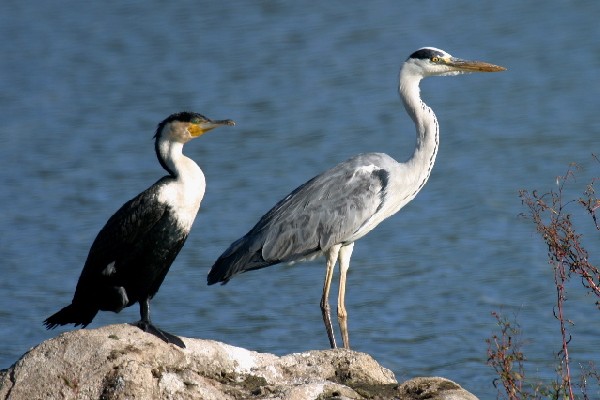
Cormorant & Grey Heron Heronry — Zwillbrocker Venn, NRW
The Zwillbrocker Venn peat bog near the Dutch border hosts Germany's largest mixed cormorant-grey heron colony — over 3,000 nesting pairs of great cormorants and 200+ pairs of grey herons crammed into the same island woodland in a tumult of croaking, flapping and aerial jousting visible from the bog-edge observation hides. Black-headed gulls, shovelers and Europe's most inland population of black-winged stilts also breed here, making the Ramsar-protected bog one of the most extraordinary bird spectacles in western Germany.
About this spectacle
Standing at the bog-edge observation hides of Zwillbrocker Venn, visitors are engulfed in one of western Germany's most visceral bird spectacles. Over 3,000 nesting pairs of great cormorants pack the island woodland alongside 200+ pairs of grey herons, filling the air with a continuous wall of harsh croaking, rattling bills and the rush of wings as birds launch and land in near-constant rotation. The visual contrast is striking: coal-black cormorants with vivid throat patches jostle against the slate-grey elegance of herons, while aerial jousting erupts without warning above the canopy. The same island hosts breeding black-headed gulls, shovelers and the rare black-winged stilts — Europe's most inland breeding population. The surrounding peat bog amplifies every sound across open water, and at dawn the colony erupts into a wall of noise and motion. The hides allow close, comfortable observation of nesting behaviour, chick-rearing and territorial disputes unfolding simultaneously across the colony.
When to go
Jan — Dec, peak Mar — Jun
Getting there
Nearest airport: MUE. Nearest city: Münster.
Booking options
Goyova doesn't process bookings directly. When you tap "Plan this trip" in the app, you'll see options from our partner providers — accommodation, tours, transport — with affiliate links where applicable. See our affiliate disclosure for details.
More like this.
 Peak season
 Aardvark Night Foraging — Kalahari Botswana
Maun, Central District, BW
 Peak season
 Aardvark Night Foraging — Kalahari South Africa
Upington, Northern Cape, South Africa
 Returns Jan 2027
 Adélie Penguin Highway — Ross Sea Antarctica
Cape Royds, Antarctica, AQ