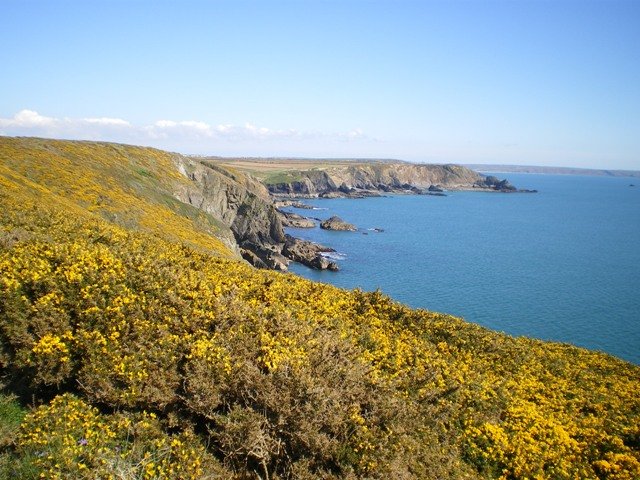
Chough Coastal Colony — Lizard Peninsula
Each spring and summer, the clifftop grasslands of the Lizard Peninsula in Cornwall host the only breeding choughs in England — a population recolonised naturally from Wales in 2002 after a 50-year absence — creating one of British conservation's most celebrated recent success stories and providing a wildlife encounter of considerable rarity with this spectacular red-billed crow on England's most southerly mainland. The chough's acrobatic cliffside flight — the birds tumbling and diving in the updrafts above the Lizard's serpentine sea cliffs with their curved red bills catching the sunlight — is one of the most exciting corvid displays in Europe, and the birds' confiding behaviour around the traditional cattle-grazed coastal turf where they probe for invertebrates allows extended close observation. The Lizard's unique geology — the largest outcrop of serpentinite rock in Britain — creates a purple-green coastal heathland flora found nowhere else in England, and the combination of the rare geology, endemic plants, and the chough creates a wildlife and botanical experience of considerable scientific distinctiveness. RSPB wardens provide telescopes at the Kynance Cove viewpoint during the breeding season, and the birds' nest sites on the sea cliffs below are sometimes visible from the coast path. The chough family parties in late summer, with recently fledged young birds still showing their coral-red bills and legs, create the most accessible and endearing chough encounters.
About this spectacle
Stand on the clifftop turf above Kynance Cove and watch for the flash of red — bill and legs bright as sealing wax — as choughs tumble and wheel in the updrafts rising off the Lizard's ancient serpentine cliffs. These are England's only breeding choughs, naturally recolonised from Wales in 2002 after a 50-year absence, and watching them probe the short cattle-grazed sward for invertebrates, calling with their sharp, carrying 'chee-ow', is a genuinely moving wildlife encounter. In late summer, family parties gather on the coastal grassland, the fledglings' coral bills catching the light as they practice the acrobatic flight that defines this corvid. RSPB wardens station telescopes at the viewpoint during breeding season, sometimes offering views of nest sites in the cliff faces below. The surrounding coastal heath — its purple and green hue unique to the serpentinite geology — frames every encounter in an extraordinary botanical context found nowhere else in England. Mornings offer the best light and liveliest bird activity.
When to go
Mar — Oct, peak Apr — Aug
Getting there
Nearest airport: NQY. Nearest city: Truro.
Booking options
Goyova doesn't process bookings directly. When you tap "Plan this trip" in the app, you'll see options from our partner providers — accommodation, tours, transport — with affiliate links where applicable. See our affiliate disclosure for details.
More like this.
 Peak season
 Aardvark Night Foraging — Kalahari Botswana
Maun, Central District, BW
 Peak season
 Aardvark Night Foraging — Kalahari South Africa
Upington, Northern Cape, South Africa
 Returns Jan 2027
 Adélie Penguin Highway — Ross Sea Antarctica
Cape Royds, Antarctica, AQ