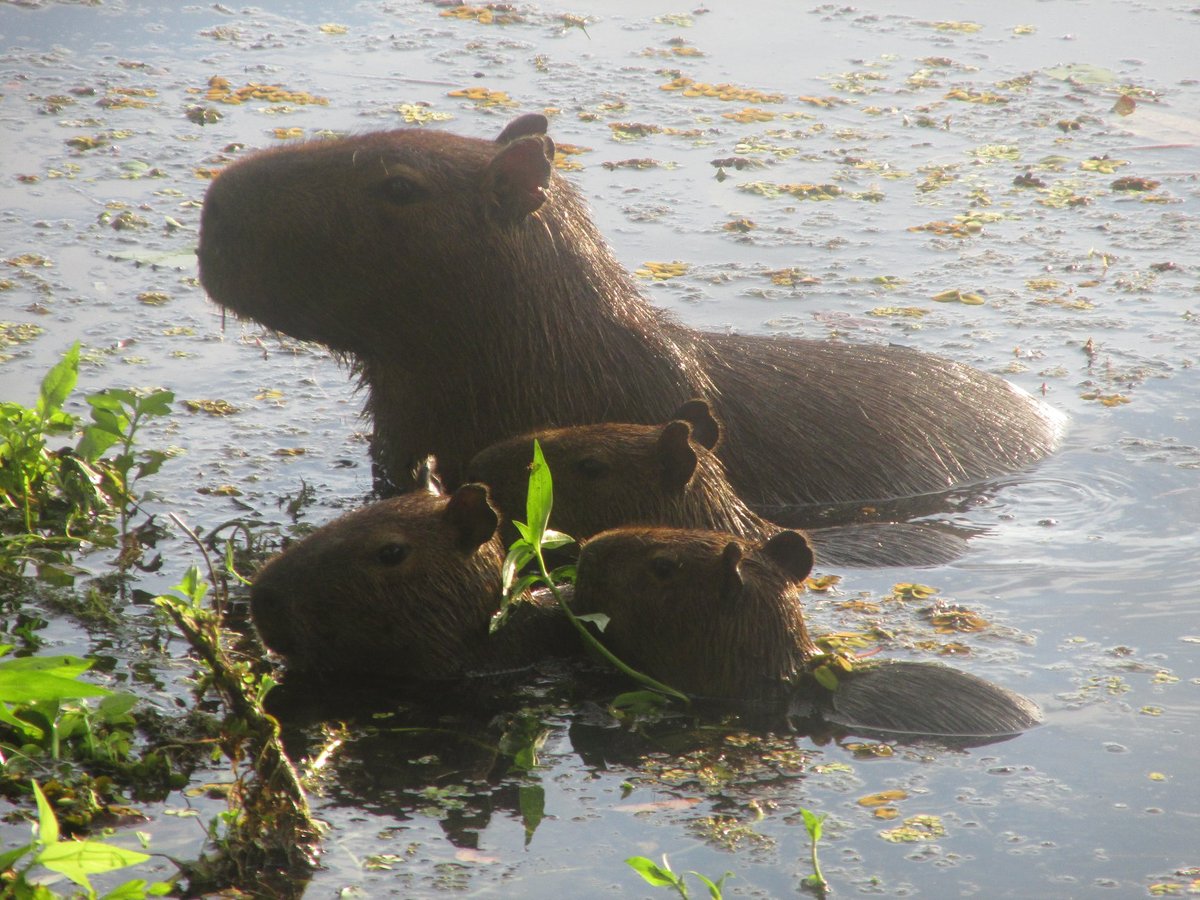
Capybara River Aggregation — Llanos Venezuela
The capybara (Hydrochoerus hydrochaeris) — the world's largest rodent at 70 kg and 1.3 metres, a semi-aquatic grazer that forms aggregations of 50–100 individuals around the drying water holes of the Venezuelan and Colombian Llanos in the dry season from December through April — creates South America's most relaxed and most accessible large mammal encounter. The capybara's combination of its complete social confidence (the aggregations include animals at every life stage, from newborns riding on adults' backs to old males visible by the pronounced cassoar on the snout), the bird epiphyte community living on the capybara's backs (the yellow-headed caracara and the wattled jacana both forage on capybara skin), and the Llanos' extraordinary bird diversity (the same pools supporting jabiru, scarlet ibis, and 300 other species simultaneously) create one of South America's finest single-site wildlife concentrations. The capybara's legendary placidity (groups allow approach to 3 metres before slowly walking away) creates the most physically accessible large mammal encounter in South America.
About this spectacle
Stand at a drying pool on the Venezuelan Llanos during the dry season and you may find yourself within three metres of a huddle of fifty or more capybaras — barrel-bodied, amber-furred, and entirely unconcerned by your presence. Newborns nap draped across adults' backs while yellow-headed caracaras hop between shoulders, picking ticks from leathery skin. Wattled jacanas step delicately across snouts. Beyond the capybara aggregation, the same shallow pool hosts jabiru storks wading in slow arcs, scarlet ibis burning orange against green grass, and a continuous traffic of herons, ducks, and shorebirds. The air carries the low, resonant bark of capybaras communicating across the water. This is watching a whole ecosystem conduct itself at arm's length — no hide, no telephoto required. Every life stage of the world's largest rodent is on display: tiny young, mid-sized juveniles, and old males whose prominent nasal gland knobs mark decades of social hierarchy. The Llanos light at dawn is warm and flat, ideal for photography. The sense of wildness is profound despite the animals' relaxed proximity.
When to go
Dec — Apr
Getting there
Nearest airport: BRM. Nearest city: Barinas.
Booking options
Goyova doesn't process bookings directly. When you tap "Plan this trip" in the app, you'll see options from our partner providers — accommodation, tours, transport — with affiliate links where applicable. See our affiliate disclosure for details.
More like this.
 Peak season
 Aardvark Night Foraging — Kalahari Botswana
Maun, Central District, BW
 Peak season
 Aardvark Night Foraging — Kalahari South Africa
Upington, Northern Cape, South Africa
 Returns Jan 2027
 Adélie Penguin Highway — Ross Sea Antarctica
Cape Royds, Antarctica, AQ